
With the 115 bps reduction in repo rate beginning February, banks have already transmitted 72 bps to the customers on fresh loans and some large banks have transmitted as much as 85 basis points.

During the fourth quarter of last fiscal, the economy had grown at a nine-year low rate of 5.3 per cent. During the entire fiscal of 2011-12, the economy grew by 6.5 per cent.

All policy planners want low interest rate, says Jaitley

At a meeting of finance officials from the Group of 20 leading economies in Istanbul.

There is evidence of asymmetric adjustment to monetary policy

Analysts and economists say that it is too early to expect anything dramatic on the interest rate regime despite the recent reform measures.

Gold prices hit a fresh record high of Rs 84,900 per 10 grams in the national capital on Friday, driven by robust domestic demand and strong global cues, according to the All India Sarafa Association. The precious metal of 99.9 per cent purity continued its ascent for the third straight session, jumping by Rs 1,100 to hit a new peak of Rs 84,900 per 10 grams.

From the 30 Sensex firms, Mahindra & Mahindra, JSW Steel, Maruti, Tata Steel, Larsen & Toubro, ICICI Bank, Power Grid, Nestle, Bharti Airtel and Adani Ports were the biggest gainers. Tata Consultancy Services emerged as the only laggard.

On the back of sound macroeconomic policies and softer commodity prices, India's growth momentum is likely to be sustained in 2023-24 in an atmosphere of easing inflationary pressures, said the Reserve Bank's annual report released on Tuesday. It, however, added that slowing global growth, protracted geopolitical tensions and a possible upsurge in financial market volatility following new stress events in the global financial system could pose downside risks to growth. "On the back of sound macroeconomic policies, softer commodity prices, a robust financial sector, a healthy corporate sector, continued fiscal policy thrust on quality of government expenditure, and new growth opportunities stemming from global realignment of supply chains, India's growth momentum is likely to be sustained in 2023-24 in an atmosphere of easing inflationary pressures," it said.

Amid fears of a third wave of coronavirus pandemic and hardening of retail inflation, the Reserve Bank is likely to maintain status quo on interest rate and watch the developing macroeconomic situation for some more time before taking any decisive action on monetary policy. The RBI is scheduled to announce its bi-monthly monetary policy review on August 6 at the end of the three-day meeting -- August 4-6 -- of the Monetary Policy Committee (MPC). The RBI Governor-headed six-member MPC decides on the key policy rates.

With rising credit demand, cleaner balance sheets, and renewed investor confidence, banks are positioned at the forefront of the market rally. From major players like ICICI and HDFC to broader policy shifts, there's much driving this momentum.
With rising credit demand, cleaner balance sheets, and renewed investor confidence, banks are positioned at the forefront of the market rally. From major players like ICICI and HDFC to broader policy shifts, there's much driving this momentum.
With rising credit demand, cleaner balance sheets, and renewed investor confidence, banks are positioned at the forefront of the market rally. From major players like ICICI and HDFC to broader policy shifts, there's much driving this momentum.

TCS was the biggest loser in the Sensex pack, sliding 3.17 per cent, followed by HCL Tech, Yes Bank, IndusInd Bank, RIL, ICICI Bank, Infosys, Tata Steel, Kotak Bank and L&T, down up to 2.34 per cent.


The Wall Street major Morgan Stanley has upgraded India to "standout overweight" citing that the relative economic and earnings growth is improving and the macro-stability setup looks sufficient to withstand the higher real rate environment. "India remains standout overweight. "We increase our overweight stance on Indian equities and as our most-preferred emerging market," the brokerage said in a note on Friday.

The wholesale inflation rose for the third consecutive month in May at 2.61 per cent on account of rise in prices of food articles, especially vegetables, and manufactured items. The wholesale price index (WPI) based inflation was 1.26 per cent in the previous month. It was (-) 3.61 per cent in May 2023. "Positive rate of inflation in May, 2024 is primarily due to increase in prices of food articles, manufacture of food products, crude petroleum & natural gas, mineral oils, other manufacturing etc," the ministry of commerce & industry said in a statement on Friday.
The study points out that for the determination of growth and investment at the macroeconomic level, the real interest rate is more relevant, even though the nominal interest rate is important for investment planning at the firm level.

Other bankers who attended the meeting at Mint Street included SBI chairman-cum-managing director O P Bhatt, ICICI chief executive and MD Chanda Kochhar, Standard Chartered's India head Neeraj Swaroop and HDFC Bank MD Aditya Puri, among others.

The paper seems to be suggesting strongly that the tight target range be maintained even as the central bank is all set to miss the target range for three consecutive quarters because of the Covid crisis.

While India won't be immune to global spillovers, we need to create the macro preconditions for sustained growth. Policy agility, prudence, and resilience will be key, suggests Sonal Varma.

India's pharmaceuticals and medical devices industries are still hopeful that trade negotiations with the US could cut a fairer deal for both sides, after President Donald Trump announced a 25 per cent tariff rate on India on a social networking platform without divulging the finer details.
The Reserve Bank of India (RBI) has barred four non-banking finance companies (NBFCs), including two microfinance institutions (MFIs), from sanctioning and disbursing loans for charging exorbitant interest rates to the borrowers. These four entities are Asirvad Microfinance, Arohan Financial Services (also an MFI), DMI Finance, which provides personal, consumption, and micro, small and medium enterprises loans, and Flipkart co-founder Sachin Bansal's Navi Finserv, which offers home and personal loans. The ban will take effect on October 21 to "facilitate closure of transactions in the pipeline", the regulator said in a statement.

Reserve Bank of India Governor Shaktikanta Das on Friday said the country's economy is an island of stability despite two Black Swan events and multiple shocks. "In an ocean of high turbulence and uncertainty, Indian economy is an island of macroeconomic and financial stability," Das told reporters during the post policy press conference. He said the financial stability, macroeconomic stability and resilience of growth is being witnessed despite two Black Swan events happening one after the other and multiple shocks.

Retail inflation eased to an 11-month low of 4.83 per cent in April as prices of some kitchen items declined though overall food basket firmed up marginally, according to a government data released on Monday. The Consumer Price Index (CPI)-based retail inflation was 4.85 per cent in March. It was 4.7 per cent in April 2023.
WPI-based inflation falls to 5-month low of 6.16%.

The International Monetary Fund (IMF) on Tuesday slashed India's growth forecast for 2022-23 (FY23) by 80 basis points to 7.4 per cent, citing less favourable external conditions and rapid policy tightening by the central bank. In its update to the April World Economic Outlook, the IMF said that though a global recession in 2022 was ruled out with a growth estimate of 3.2 per cent, the balance of risks was squarely to the downside, driven by a wide range of factors that could adversely affect the global economic performance. "The risk of recession is particularly prominent in 2023, when in several economies growth is expected to bottom out, household savings accumulated during the pandemic will have declined, and even small shocks could cause economies to stall.

From the 30 Sensex pack, State Bank of India, Mahindra & Mahindra, Bharti Airtel, Titan, HDFC Bank, IndusInd Bank, Axis Bank and Bajaj Finance were the biggest laggards. JSW Steel, Tech Mahindra, Larsen & Toubro, Hindustan Unilever, HCL Technologies and Reliance Industries were among the gainers from the pack.

The Indian government has introduced a bill in the Lok Sabha to ban online games played with money, aiming to curb addiction, money laundering, and financial fraud. The bill also targets advertisements and financial transactions related to such games.
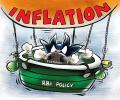
The Reserve Bank of India on Friday raised the retail inflation target for the current financial year to 5.7 per cent on the back of rising global prices amidst the ongoing geo-political tensions, even as it expected the prices of cereals and pulses to soften on prospects of good winter crop harvest. "Global food prices along with metal prices have hardened significantly. "Economy is grappling with a sharp rise in inflation... Inflation is now projected at 5.7 per cent in 2022-23 with Q1 at 6.3 per cent; Q2 at 5 per cent; Q3 at 5.4 per cent and Q4 at 5.1 per cent," RBI Governor Shaktikanta Das said while unveiling the first monetary policy review for the current fiscal year.

Analysts at Barclays pitched for a 0.25 per cent cut to generate demand advising the central bank to throw caution to the wind.

'India's emergence as a top crypto market comes despite a regulatory and tax environment that can be challenging for the industry to navigate.'
The government on Monday ruled out making public the RBI report detailing the reasons why the central bank could not keep inflation within the targeted 6 per cent upper limit for the three consecutive quarters. "Yes sir, RBI has furnished a report to the central government, as mandated under Section 45ZN of the RBI Act, 1934 and Regulation 7 of RBI Monetary Policy Committee and Monetary Policy process Regulations, 2016," minister of state for finance Pankaj Chaudhary said in a written reply. The said provisions of the RBI Act, 1934, and regulations therein does not provide for making the report public, he said.

The Reserve Bank of India's (RBI's) interest rate decision, West Asia conflict and trading activity of foreign investors are the key factors that will dictate investors' sentiment in the market this week, analysts said. Moreover, quarterly earnings from IT bellwether TCS, domestic macroeconomic data and movement in global oil benchmark Brent crude would also guide trends in the market. Worsening tensions in the Middle East and foreign fund outflows were the major culprits behind the equity markets sharp fall last week.

Pressure has been mounting on the Reserve Bank of India to cut interest rates in the wake of declining retail inflation and the need to fuel growth momentum. However, the RBI will have to do a tightrope walk as globally interest rates are inching upwards.

'Investors need to expect steady returns over the next one to two years with bouts of high volatility.'

RBI Governor D Subbarao is expected in the capital on Friday to hold pre-policy consultations with Finance Ministry officials.

India has decided to submit a dossier at the upcoming Financial Action Task Force (FATF) meeting, calling for Pakistan to be placed back on the grey list of the global money laundering and terrorist financing watchdog.

Central bank estimate economy to grow at 5.5 per cent.

Auto stocks will be in focus
